
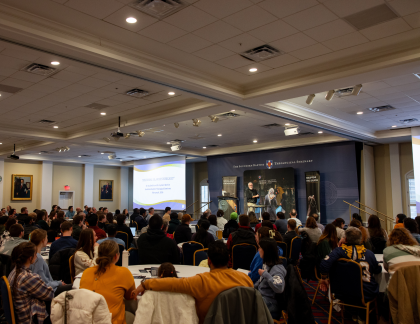
The Jenkins Center for the Christian Understanding of Islam recently had the privilege of welcoming Dr. Jay Smith to The Southern Baptist Theological Seminary for the spring Academic Lecture series. With over 40 years of experience in the field of Muslim-Christian apologetics as well as a PhD in apologetics and polemics from the Melbourne School of Theology in Australia, Smith brought a wealth of knowledge, experience, and passion to the table.
The event consisted of a two-part lecture in which Smith shared a summary of some of his recent scholarly contributions to the field of Muslim-Christian apologetics. In particular, he employed a host of critical questions and perspectives that shed light on the very foundations of Islam–namely, on the origins of Mecca, Muhammad, and the Qur’an. He argued that if any one of these three “pillars” of Islam’s traditional narrative can be shown to be false, then the entire foundation of Islam will be brought into question and effectively dismantled.
And yet, for Smith the heart of this work is far from being merely an academic pursuit in the field of Islamic studies; rather, it is a Christ-centered mission to pursue honest critical scholarship that seeks to understand Islam for what it truly is and was, with the end goal of helping Muslims around the world to do the same and thereby find freedom in the gospel of Jesus Christ. From the very beginning of his lecture, Smith clarified that his aim is not to shut down Muslims–whom he rightly considers to be some of the greatest people in the world–but rather to shut down Islam. It is, in fact, this very love for Muslims that has led him to engage in apologetics and polemics against the ideologies of Islam.
The first lecture began with a plea for Christians to engage in the eternally important task of proactively defending Christianity and challenging Islam, especially in light of the reality that Islam is no longer a disembodied religion “over there,” but has now gained a significant presence here in the West. He highlighted how Muslims have long been quick to challenge the claims of Christianity and engage Christians in the public sector, while Christians have largely been hesitant to reciprocate this in any meaningful way. No longer, he argued, can we afford to shy away from this task; we must engage with Muslims, employing both their own Muslim sources as well as recent critical scholarship that has shed light on the nebulous origins of Islam.
Smith brought attention to the fact that while most of the approaches to reaching Muslims in the West have been born out of missionary efforts in the Middle East (where missionaries often had to be exceptionally unconfrontational and tactful in their method due to the local religious culture and the risk of persecution), the majority of Muslims around the world are actually not from the Arab world (nor do they speak Arabic), and are much more comfortable with open and even confrontational religious dialogue. Thus, according to Smith, Christians have largely overlooked the opportunity to use apologetics and polemics with Muslims in order to challenge the very foundations of Islam. We have, in essence, traded speaking the truth (albeit in love) for tactics that prioritize “peace” and friendship.
Following in the footsteps of revisionist Islamic historian Patricia Crone, Smith shared a host of intriguing findings from his years of research, exposing what he deemed to be many irreconcilable problems with the origins of Islam. Perhaps most prominent among these findings was the lack of any compelling evidence for the existence of Mecca, the very birthplace and heart of Islam: If indeed Mecca is the oldest and the most well-known and theologically significant city in the history of the world, as Muslims claim, then why is there no evidence of its existence in the centuries leading up to the advent of Islam? No less troubling to the standard Islamic narrative regarding Mecca is the fact that the Arabic word endings in the Qur’an are from a Nabatean dialect hundreds of miles to the north of Mecca, as well as the fact that the humble smattering of geographic references in the Qur’an are also all located far too north to give credence to the validity of Mecca.
Moreover, Smith drew attention to additional problems with the foundations of Islam, including the borrowing of Jewish customs that made their way into the Islamic practice of hajj, the evidence from Arab coins following the initial spread of Islam that appear to be more anti-trinitarian than distinctly “Muslim” in nature, and the intriguing proposal that the Arabic m-ḥ-m-d root of Muhammad meant “the praised one” and possibly was used in reference to Jesus instead of the Prophet Muhammad of Islamic history. Smith also challenged the validity of the Qur’an, pointing to evidence of the myriad textual discrepancies between different versions over the years as well as the piecemeal and incomplete nature of its contents. With regards to the hadith, which are equally foundational to Islam, he shared compelling evidence that these collections of Islamic traditions were authored hundreds of years too late and hundreds of miles too far north of the Hijaz.
It is perhaps an understatement to say that the students and faculty members in attendance were deeply challenged and inspired. Smith’s lectures were both weighty and accessible, offering much food for thought for those who were already steeped in Islamic studies as well as for those with no prior knowledge or experience with Islam. If, as Smith suggested, Islam could be depicted as a “three-legged stool”–based on a book (the Qur’an), a man (Muhammad), and a place (Mecca)–then his presentation effectively challenged all three of those foundational pillars of this religion that has captured the minds and hearts of some two billion people around the world. Even still, his goal and therefore his challenge to us is not simply to have the tools to dismantle the foundations of Islam, as important as that is; rather, it is to love Muslims fully by presenting them with the hope and truth of Jesus Christ. As Smith put it so beautifully and succinctly, we as Christians are the only ones who have an answer; we have the only book, the only Man, and the only place which have passed the deepest of criticisms and can uniquely offer true and eternal life to a lost and dying world.