
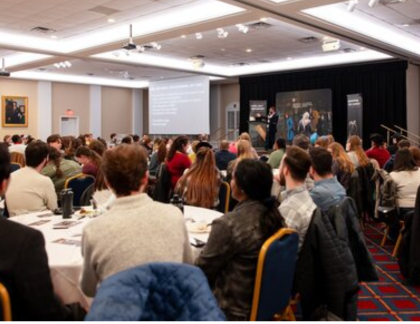
One of the greatest joys of the Jenkins Center is hosting events that provide an opportunity to hear what the Lord is doing in places of great need, difficulty, and opportunity. On Friday, February 21, we had the privilege of hosting Pastor Nader Maurice, who serves as the Executive Pastor at Kasr El Dobara, the largest evangelical church in the Arab world. He also serves as a facilitator for a global youth movement, bringing together Christians from more than 80 countries. He was born and raised in Cairo, Egypt, where he and his family reside.
Maurice told the story of the Egyptian church. It began in Acts 2, when those in Jerusalem at Pentecost heard the Gospel and returned home. The apostle Mark ministered in Egypt; other influential leaders, such as Athanasius, rose up from the Egyptian church. Egypt was a Christian nation until the eighth century, when Islam invaded and Christians fled. Now, Egypt is one of the most influential Islamic nations. If Saudi Arabia is the heart of the religion, Egypt is the head, with Al-Azhar University training millions of students in the ways of Mohammed.
This is not the end of the story, however; God is moving in amazing ways. Fifty years ago, small groups of Christians started praying for the redemption of Egypt in a time when the church was very divided and a great deal of fear hindered evangelism. As the Spirit of God began to move in answer to the prayers of His people, fear of evangelism began to disappear. Media provided fresh avenues for this, specifically through satellite television. In late 2010, one church leader stated, “It’s been 40 years since we started praying and waiting for a revival, for millions of people to come to know Jesus. The turning point is around the corner.”
The following year, the Arab Spring came to Egypt. Maurice’s church was turned into a field hospital, providing an incredible opportunity to serve the community and be a witness for Christ. CNN ran a month-long livestream of the “church of the hospital.” As Christians prayed for God to make Himself known, tremendous opportunities for evangelism and ministry opened up. Arab Spring led to a shaking of established structures and norms, fresh seeking after God and truth, and unprecedented freedom. Many Egyptians were seeing visions and dreams of Jesus, coming to hear of Him with hearts ready to receive Him.
Along with the new openness for evangelism came a fresh unity in the church as they worked and prayed together for the advance of the Gospel.
On New Year’s Eve, thousands of people gathered in the square for a candlelight service, expecting an appearance of Jesus. Though Jesus did not physically manifest Himself, the event was televised, and the most popular newspaper included a picture with the headline “Christians brought Jesus to Tahrir Square.”
Another noteworthy gathering occurred on November 11, 2011, when 50,000 believers congregated at a Coptic cave church for a night of worship and prayer. For seven entire minutes, the place shook with the name of Jesus. God also did an incredible work among church leaders. In a time of division, the influence of the church was weak. However, God brought about a huge breakthrough as leaders of all denominations came together for a meeting of reconciliation through repentance that led to unification in love.
As God brought revival to the church, hundreds of thousands of Muslims started coming to know Christ. Media ministry today is exploding, and the Gospel is being shared as churches are engaging in the task of evangelism. The heart of the movement is among the youth, involving worship, discipleship and missions; the current generation of youth are more open to debate and unafraid to ask questions. Many people are dissatisfied with Islam and have become atheist or agnostic; others are earnestly searching for truth. Believers from Muslim backgrounds are being integrated into the church.
Amidst marvelous growth, there is still opposition and persecution. Maurice shared 1 Corinthians 13:13, “So now faith, hope, and love abide, these three; but the greatest of these is love.” He shared specific examples of how faith, hope, and love remain. One example is that when twenty-one Egyptian Christians were publicly executed by ISIS, broadcast on TV, thousands were drawn to the Christ for whom they were willing to give their lives. Hope in Christ has been publicly attested to by a mother who lost her nine-year-old daughter to religious violence but extended forgiveness and proclaimed the Gospel. Love was demonstrated when the church opened its doors as a hospital during the revolution.
Maurice concluded by asking for prayer that more people from Muslim backgrounds would come to faith in Jesus. He then took questions from the audience, many of which revolved around Muslims coming into the church, how to reach out to them, and why youth are so integral to the movement.
In his final thoughts, Maurice reminded the audience that the key factor precipitating this current flourishing of ministry is prayer. Christians used to fear Muslims, but when they started praying for them, God changed their hearts to understand His love for Muslims. Nothing of lasting value can be accomplished apart from prayer or without love. Maurice urged the North American church to pray God would use Christians in the Middle East to reflect His image to Muslims and join the church in Egypt in interceding for Muslims.